"How much tax will I actually owe on this?" is one of the most common questions investors ask right before they sell — and one of the hardest to answer with confidence, because the answer depends entirely on which country's tax office you're dealing with.
A flat 0% in the UAE. A flat 19% in Poland. A sliding 18%–24% in the UK. A wealth-based calculation in the Netherlands that has nothing to do with whether you actually sold anything. There's no single "capital gains tax rate" — there are dozens of different systems, and most investors only really learn theirs the hard way, at tax time.
This guide breaks down how capital gains tax works on stocks and crypto in 16 countries as of 2026, where the two asset classes are taxed identically, and where they diverge in ways that genuinely change what you should do before you sell.
How Capital Gains Tax Actually Works
Before the country-by-country breakdown, a few concepts show up almost everywhere:
- Short-term vs. long-term: Many countries (the US being the clearest example) tax assets held under a year at higher, ordinary-income rates, and reward longer holding periods with a lower rate — or no tax at all.
- Flat tax vs. progressive tax: Some countries apply one flat rate to all capital gains, regardless of income (Poland's 19%, Portugal's 28%). Others fold gains into your regular progressive income tax brackets, so your rate depends on your total income for the year.
- Realized gains vs. deemed gains: Almost everywhere, you're only taxed when you actually sell. The Netherlands is a notable exception — more on that below.
- Stocks and crypto aren't always treated the same asset class. This is the part most guides skip, and it's where the real planning decisions live.
Capital Gains Tax by Country (2026)
Here's how 16 countries currently tax gains on listed stocks and cryptocurrency for individual investors.
| Country | Stocks | Crypto | Notes |
|---|---|---|---|
| United States | 0 / 15 / 20% | 0 / 15 / 20% | Long-term rate (held >1yr), plus up to 3.8% NIIT for high earners. Short-term gains taxed as ordinary income. |
| United Kingdom | 18 / 24% | 18 / 24% | Basic-rate taxpayers pay 18%, higher-rate 24% (aligned with property rates since Oct 2024). £3,000 annual tax-free allowance. |
| Germany | ~26.4% | 0% | 25% Abgeltungsteuer + solidarity surcharge on stocks, regardless of holding period. Crypto is fully tax-free after a 1-year hold. |
| France | 30% | 30% | Flat tax (PFU) on capital income. You can opt into the progressive income tax scale instead if it works out lower. |
| Ukraine | 23% | 23% | 18% PIT + 5% military levy. A reduced transitional rate applies to certain crypto acquired before the current framework and sold in 2026. |
| Poland | 19% | 19% | Flat "Belka tax" applies equally to both, filed via PIT-38. |
| Netherlands | ~36% | ~36% | Not a real capital gains tax — Box 3 taxes a deemed yield on your total net wealth each year, whether you sold anything or not. |
| Portugal | 28% | 0 / 28% | Stocks: flat 28%, no long-term relief. Crypto: 28% if held under 365 days, tax-free if held longer. |
| Switzerland | 0% | 0% | Private investors pay no capital gains tax at all. Classified as a "professional trader" and the rules change completely. |
| India | 12.5% | 30% | Listed equity LTCG above ₹1.25 lakh/yr. Crypto is flat 30% + 4% cess with no holding-period discount and no loss offsetting. |
| Japan | 20.315% | 20.315% | Flat rate (15% national + 5% local + 0.315% reconstruction surtax) applies to both, via licensed exchanges for crypto. |
| Canada | ~13–27% | ~13–27% | Only 50% of a gain is added to taxable income and taxed at your marginal rate — so your effective rate depends on your province and bracket. |
| Australia | ~22.5% | ~22.5% | 50% CGT discount for assets held >12 months, then taxed at your marginal rate. The discount is set to change from July 2027. |
| Singapore | 0% | 0% | No capital gains tax for individuals — unless the tax authority deems your trading frequent enough to count as income. |
| UAE | 0% | 0% | No personal income tax of any kind, so no capital gains tax either. |
| Cyprus | 0% | 0% | No capital gains tax on securities, and no dividend tax for non-domiciled tax residents. |
Rates shown are general cases for individual investors and can vary with income level, holding period, or specific exemptions. This isn't tax advice — always confirm your exact situation with a local tax professional before filing.
Where Stocks and Crypto Are Taxed Completely Differently
The table above hides an important detail: in most countries, stocks and crypto face the exact same rate. But in a handful of places, the gap between the two is enormous — and it's the kind of thing that should genuinely factor into your decisions.
Germany: 26.4% vs. 0%
This is the starkest split on the list. Sell German stocks and you pay the Abgeltungsteuer no matter how long you held them. Hold crypto for over a year, and the gain is entirely tax-free — one of the more generous long-term crypto regimes among major economies.
Portugal: One Flat Rate vs. a Holding-Period Cliff
Stocks get no break for patience — 28% whether you held for a month or a decade. Crypto held for less than a year gets hit with the same 28%, but cross the 365-day mark and the gain becomes tax-free.
India: 12.5% vs. 30%
Listed Indian equities get a relatively favorable long-term rate with an annual exemption. Crypto gets none of that — a flat 30% plus a 4% cess applies from the first rupee of profit, with no discount for how long you held and no ability to offset losses against gains.
Countries With No Capital Gains Tax
The UAE, Singapore, and Cyprus stand out for taxing investment gains at 0% — but "no capital gains tax" rarely means "no tax at all." A few caveats worth knowing:
- Frequency and intent matter. Singapore, for example, can reclassify very active trading as taxable income rather than a capital gain.
- Tax residency is the real gate. These 0% rates apply to tax residents, not to anyone who happens to hold an account with a local broker.
- Switzerland's 0% only applies to private investors. Trade frequently or use leverage aggressively enough, and the tax authority can reclassify you as a professional trader — at which point gains become taxable income plus social contributions.
Skip the spreadsheet — see your exact numbers
Watchfolio's Tax Estimator applies your country's actual capital gains, dividend, and crypto tax rates to your real portfolio — so you know what you'd owe before you sell, not after.
Try the Tax EstimatorCovers 30+ countries. Free plan available.
A Quick Example
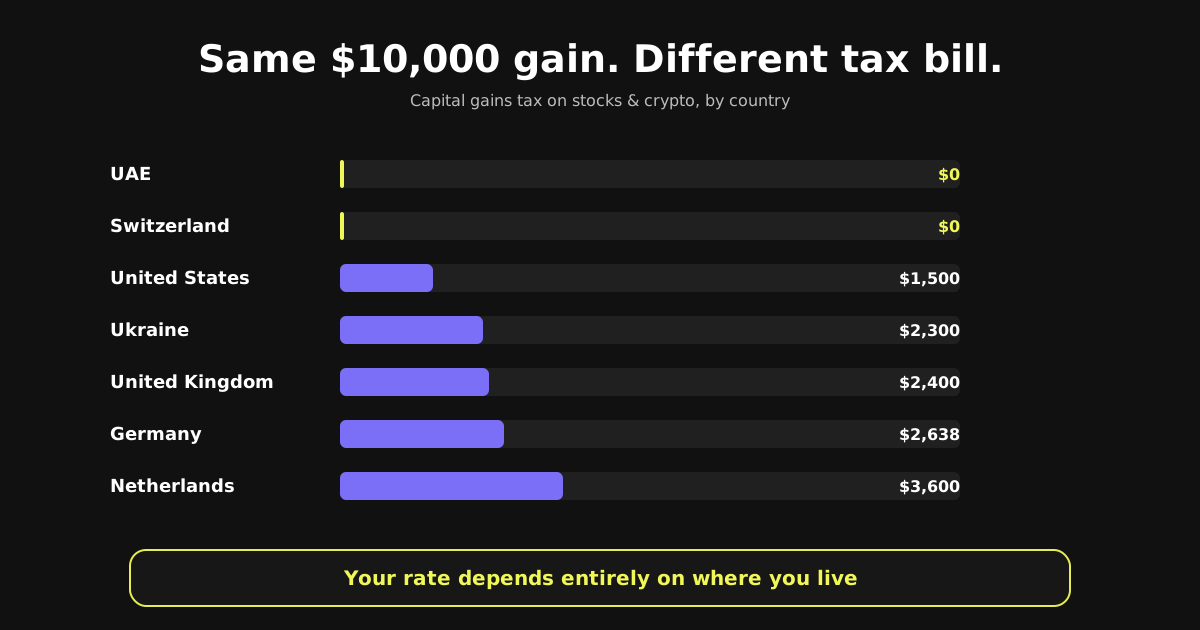
Say you have a $10,000 gain on a stock position, held for over a year. Here's what you'd keep after tax in a few of the countries above:
- UAE or Switzerland: keep the full $10,000
- United States (12% bracket): keep $10,000 (0% long-term rate applies below the threshold)
- Ukraine: keep $7,700
- United Kingdom (higher rate): keep $7,600
- Germany: keep $7,362
- Netherlands: effectively keep around $6,400, and — unlike every other country on this list — you'd owe a version of this tax annually based on your wealth, whether you sold or not
Same gain, same asset, same year. The only variable is which country's tax residency applies to you — which is exactly why this is worth checking before you sell, not after.
The Bottom Line
Capital gains tax isn't one rate you can memorize — it's a patchwork of flat taxes, progressive brackets, holding-period rules, and asset-specific carve-outs that shift from year to year. Rates that were current a year ago (the UK's 2024 hike, Canada's cancelled inclusion-rate increase, Australia's discount changes coming in 2027) show how quickly this stuff moves.
The safest approach is to check your actual numbers against your actual portfolio, not a rate you half-remember from a forum post. That's what Watchfolio's Tax Estimator is for — plug in your country and it applies the real stock, dividend, and crypto rates to what you actually hold, so the number you see is the number you'll owe.